
Platform · proposed capabilities
An execution layer for agents across the servers you already operate.
ANDIP aims to unify workload scheduling, isolated execution, visibility and recovery—without requiring Kubernetes for the initial MVP.
One system boundary, with clear ownership at every layer.
Each capability below depends on new infrastructure work and measurable engineering gates.
Unified Control Plane
Receive workflow requests, apply identity and policy checks, maintain durable execution state, coordinate scheduling and present operational context.
PlannedDistributed VPS Management
Enroll already-provisioned Linux workers, track heartbeat and resource inventory, and cordon or drain workers through explicit state transitions.
PlannedAgent Workload Scheduling
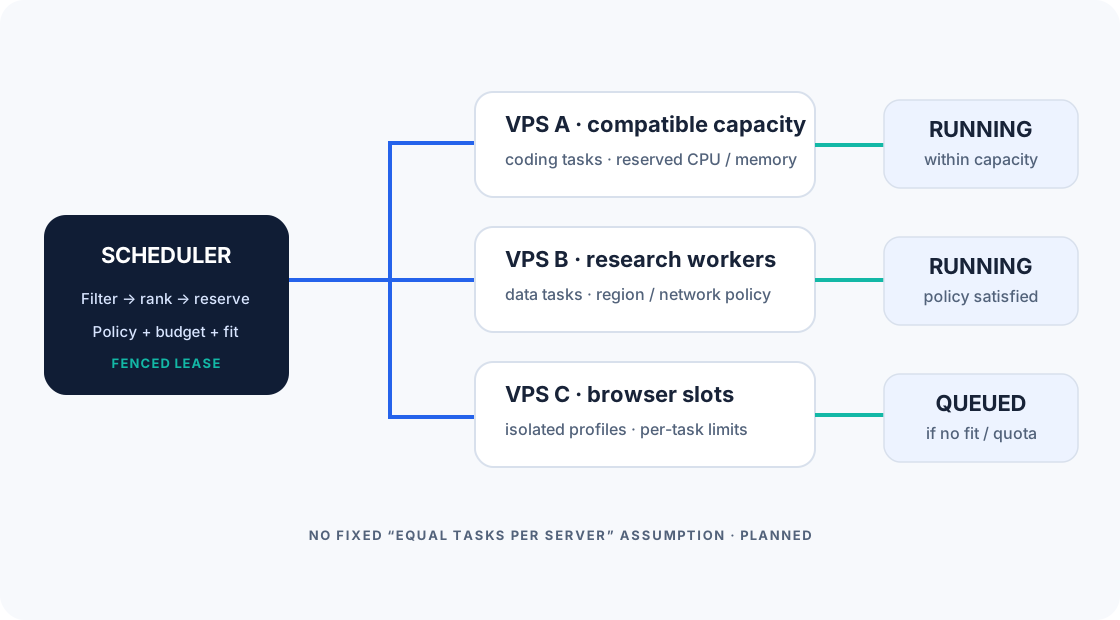
Filter workers by runtime, resource fit, region, permissions and quota; reserve capacity atomically and issue a fenced lease.
Under validationIsolated Execution
Prepare per-attempt workspaces and rootless container boundaries, with scoped secrets, resource limits and network policy.
PlannedDurable Task Processing
Persist workflow state and queue transitions so a restarted controller can reconcile leases instead of losing the record of work.
PlannedMonitoring & Audit Trails
Collect worker health, attempt events, artifact references, usage and policy decisions; distinguish stale data from current state.
PlannedResource & Budget Controls
Reserve resource and cost budgets before assignment, then meter usage and throttle or pause according to project policy.
PlannedFailure Recovery
Reconcile expired leases, apply fencing, resume compatible checkpoints, and send uncertain side effects to review before retry.
PlannedModel & Agent Extensibility
Keep agent adapters distinct from the distributed scheduler so supported runtimes and models can evolve independently.
PlannedSchedule by fit, not by a fixed count per machine.
A team connects several existing VPS instances. ANDIP would inspect declared capacity and worker health, compare each task's requirements and policy, then reserve compatible resources. Coding, research and browser work can have different profiles.
If capacity or provider quota is insufficient, work remains queued rather than being overcommitted. The intended scheduler also preserves headroom and accounts for locality, cost and worker state.
Illustrative scenario only. Worker sizes, task counts and performance outcomes are not claims about a running deployment.
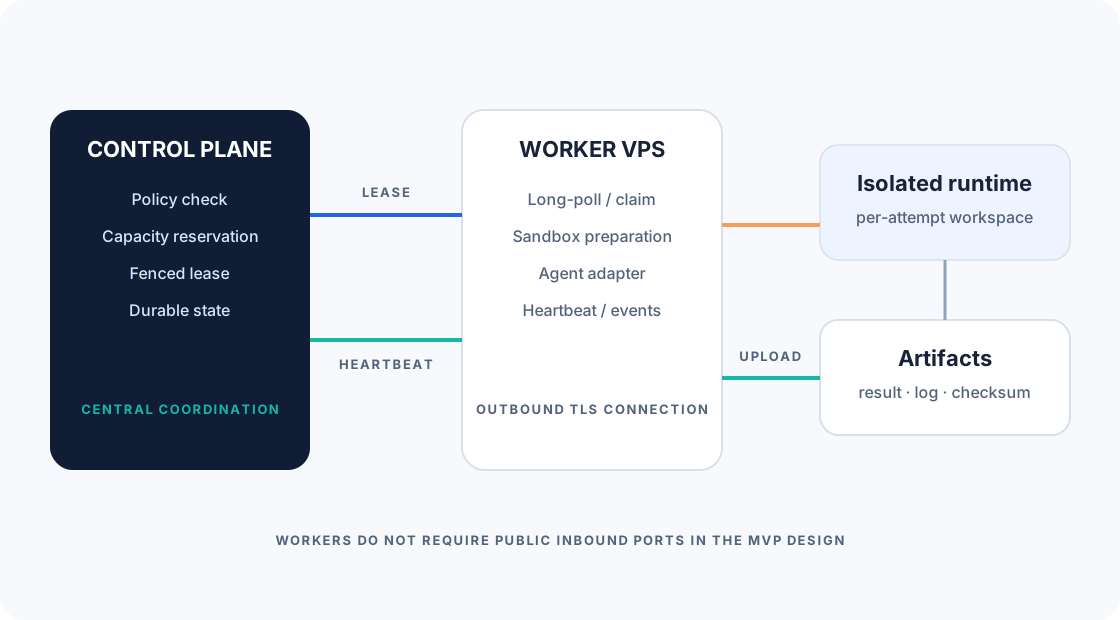
Central coordination. Distributed execution.
A centralized control plane owns project, workflow and placement decisions. Distributed workers own local execution and resource use. This split gives the scheduler a fleet-wide view while keeping agent processes on the worker that has suitable capacity.
Why not Kubernetes first?
The MVP begins with already-provisioned VPS and a worker daemon. A Kubernetes control plane would add operational components before autoscaling, managed provisioning or service-mesh requirements justify them. The architecture can revisit that choice when evidence demands it.
Agent supervision vs. infrastructure orchestration
Agent Orchestrator can supervise local agent sessions and tools. ANDIP must separately own distributed leases, worker health, durable queue state, resource reservation and cross-server recovery.
Connect a fleet, submit work, collect checked artifacts.
In this proposed scenario, the user enrolls existing VPS instances, submits several agent workloads, and reviews their progress and outputs from one control layer.
Connect existing servers
An administrator enrolls a worker with a short-lived token. The worker reports machine identity and capacity through an authenticated outbound channel.
Describe tasks and policy
A workflow is decomposed into dependent tasks with declared resource requirements, allowed tools, budget and deadlines.
Filter and reserve capacity
The scheduler filters incompatible workers, reserves a suitable slot atomically and issues a lease with a fencing generation.
Run isolated attempts
A worker prepares an attempt-specific environment, launches a selected adapter and streams progress while enforcing the declared limits.
Verify, persist and clean up
A task-specific verifier checks candidate output; artifacts are stored with checksums, then credentials and temporary resources are cleaned up.
Architecture illustration—not a proven live demonstration.